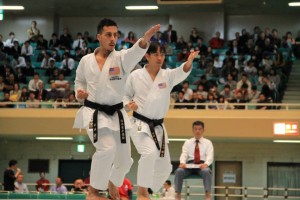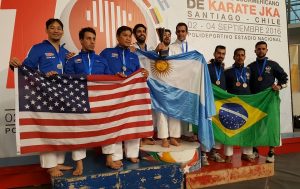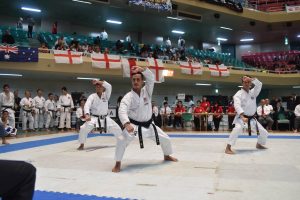
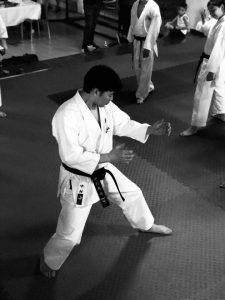
Everyone trains for different reasons for training, and Hu Shin Kai acknowledges that. Hu Shin Kai starts everyone with casual introductory classes, but each session will be often divided into different groups based on the demography of the attendees: Intensity, age group, ranks, and etc…
The decision on which group to train in is usually instructor’s decision. The desire to train in different groups may be discussed with the instructors, and the decision by the instructors must be ultimately respected by the members (and their guardians). The grouping may not be permanent, and it changes based on members’ condition. Generally speaking, there are following categories:
1. Entertainment ad Fitness: Regardless of the age, most of the people would like to learn casual level of martial arts tradition, culture, and skills. This is where everyone starts, and many people stay in this category.
2. Competitive: Competition is an exciting part of Karate. Many young members strive to do best in competition, and training is usually physically demanding.
3. Martial Arts: Martial Arts is not only about techniques and physical abilities. Not only physical aspect of the Karate is trained, non-physical part of Karate is expected to be acquired to be a Martial Artist. This is definitely not for everyone, and usually taught by invitation-only. The instruction will reach into manners, personality, behavior, and beyond, so the members and their guardians must be fully aware and agree to such instruction prior to the enrollment if asked to attend the class.
There is no written guidelines as to when or how to move from one group to another. It is up to the instructors to decide upon considering several factors.
For all categories/groups, training consists of Kata (form), Kihon (basics), and Kumite (Sparring). Only through equal training of all three factors, Hu Shin Kai recognizes the advancement of the Karate martial artist (Karate-Ka).
Kihon
Kihon means basics. Members learn the correct training methods and execution of various techniques in the Kihon training. Kihon training shares the same fundamental but changes based on levels and experience of the members. When practiced correctly with dedication, Kihon training provides correct power, speed, spirit, and timing that lethal execution of technique is possible. Such techniques can only be achieved through years of dedication, and it is not something that can bebuilt in a short period of time.
Kata
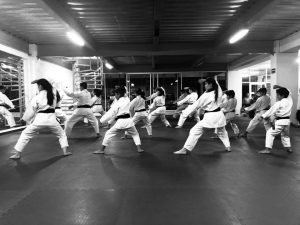
Kata means form. Karate form is different from the forms in other martial arts such as Judo or Kendo in that it is structured as series of techniques executed as a simulation of fighting against multiple opponents in various situations. Unlike the recent trend of “Kata for Competition”, Kata must be the bible of Karate, and spending lifetime to study Kata has always been the most important part of martial artists of Karate lineage. While competition is important, Hu Shin Kai trains Kata as a training method for Karate as a whole, positioning it as vital training method to get better in Kihon and Kumite.
Kumite
Kumite is sparring. Traditional Karate in Japan is known for preserving its martial arts flavor in its sparring. Japanese Karate-ka show this side in tournaments and non-tournament sparring. While the Japan standard shows very aggressive sparring style, the training and sparring itself is very structured and safe. Our members have been known for their success but with least injuries caused by the Kumite.
Our mission is to safely and structurally instruct sparring as safely as possible, but make sure that everyone who continue to train will be able to spar. It is not our intent that only young ones are able to spar, but we assure that all members will be able to spar safely but effectively.
No members will be forced to spar nor thrown into sparring without enough instruction. In fact, we generally prohibit members to spar without instructors’ presence and permission until they achieve certain level.
Students will learn several sparring training methods prior to free-sparring:
3 or 5 step sparring – 3 or 5 steps of agreed offensive and defensive movements between two people executed in a straight line. This practice allows the correct execution of offensive and defensive techniques with correct timing, target, and distance.
1 step sparring – In this training, the offensive side announces the target and technique to be executed over one step. The defensive side is allowed to use different angle, defensive techniques, and counter techniques.
Semi-free sparring – This is similar to 1 step sparring, but both sides begins with the “free-style”. More realistic distance, timing, and execution of techniques are required, and it is often used as the final training method prior to free sparring.
Free Sparring – Free sparring is conducted freely among two or more people. This training occurs in several different form. For example, the tournament free sparring is an environment controlled by a set of rules to compete. Jigeiko or Randori are the terms used for free sparring outside of the tournament. This training method is used mostly in the dojo for more realistic situations where less rules are applied.
Summary
Kihon, Kata, and Kumite are equally important in traditional Karate. It is not an ideal environment to focus only in one area. Refer to other links to understand the philosophy of the Japanese Karate.
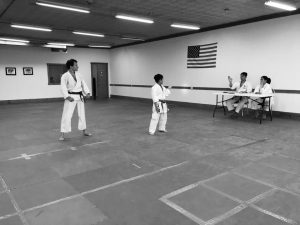
ExamsExaminations will be conducted periodically to progress ranks. The belt exams occur generally every 3 months, but it only occurs when there are members who show the qualification in physical and mental ability to progress to the next level. Exams are conducted according to the traditional Karate syllabus and standard, which includes all 3 categories of physical training: Kihon, Kata, Kumite (outlined in the “Training” tab above). In addition, attitude, manner, and consistency input by the instructors are considered for the eligibility to take the exam. So anything from proper greeting to cleaning the dojo are methods of training each one of us at all times. The examination usually occurs at the Hu Shin Kai location, but they are also conducted at the national seminars and tournaments. Members must consult the Hu Shin Kai instructor prior to taking exams in other locations than Hu Shin Kai. The certifications will be provided to the members who pass the exam.
The ranks progression path is as following:
White (9 Kyu / 10 Kyu)
Yellow (8 Kyu)
Orange (7 Kyu)
Green (6 Kyu)
Purple (5 Kyu)
Purple (4 Kyu)
Brown (3 Kyu)
Brown (2 Kyu)
Brown (1 Kyu) *minimum 1 year in 1 Kyu before qualifying for the Shodan (1st degree Black Belt) exam.
Black (Sho Dan+)
**minimum # of years before qualifying for the next exam = # rank. For example, minimum of 3 years is required for San Dan (3rd degree black belt) to be able to take the next exam.
In addition to the ranking examinations, there are certification examinations for 2 Dan (2nd degree black belts) and higher. Such examinations consist of Instructor, Judge, and Examiner. These certifications are conducted by the presence of many high-rank examiners. Such examinations and certifications are not related to the rank of the belt. They are optional and separate measures to ensure the quality of instructors, judges, and examiners.
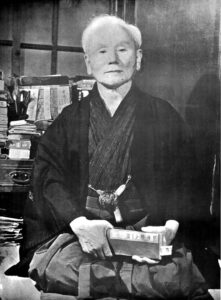
Dojo kun is a Japanese martial arts term literally meaning (training hall) rules. They are generally posted at the entrance to a dojo or at the “front” of the dojo (shomen) and outline behavior expected and disallowed.
Hitotsu! Jinkaku kansei ni tsutomuru koto.
Seek perfection of character
Karate is more than just a way to work out, it?s a character building experience. For the beginner, the process begins with practicing techniques by means of repetition in order to build on a skill set. The road is long and arduous, but karate training teaches?students to embody the spirit of perseverance by?overcoming the challenges karate training brings. This not only applies to karate, but to life in general.
Hitotsu! Makoto no michi o mamoru koto.
Be faithful
Guarding and defending the way of truth means that one is expected to embody, teach, and share the ?correct path? of improvement and integrity with others and not simply and passively follow it alone. The spirit of karate is about helping each other to improve together, not selfishly working for one?s own interests without considering the welfare of others.
Hitotsu! Doryoku no seishin o yashinau koto.
Endeavour
Fostering the spirit of effort requires dedication and commitment to achieving great things in karate. It requires giving our all, no matter the circumstances. In no case is mastery of the art possible without maximum effort and sacrifice.
Hitotsu! Reigi o omonsuru koto.
Respect others
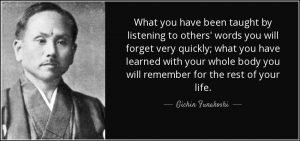
Respect for others is a very integral part of Japanese culture, and thereby karate.?Gichin Funakoshi, the founder of Shotokan Karate-do, stressed that karate begins and ends with etiquette, and that without courtesy there is no dojo. This rings true in all corners of the dojo, from bowing to your sensei to respecting your classmates and helping them to succeed. This respect of others transcends dojo boundaries and infuses with our day-to-day lives, where we respect our teachers, peers, family, and friends.
Hitotsu! Kekki no yu o imashimuru koto.
Refrain from violent behavior
An individual trained in the art of karate is a lethal weapon, possessing the tools to seriously injure an untrained person. What defines a karate practitioner is his or her character. Guarding against impetuous courage means that no matter what happens to the karateka, they will always remain in control of their emotions and will never use karate maliciously to prove a point, show off, or otherwise.?
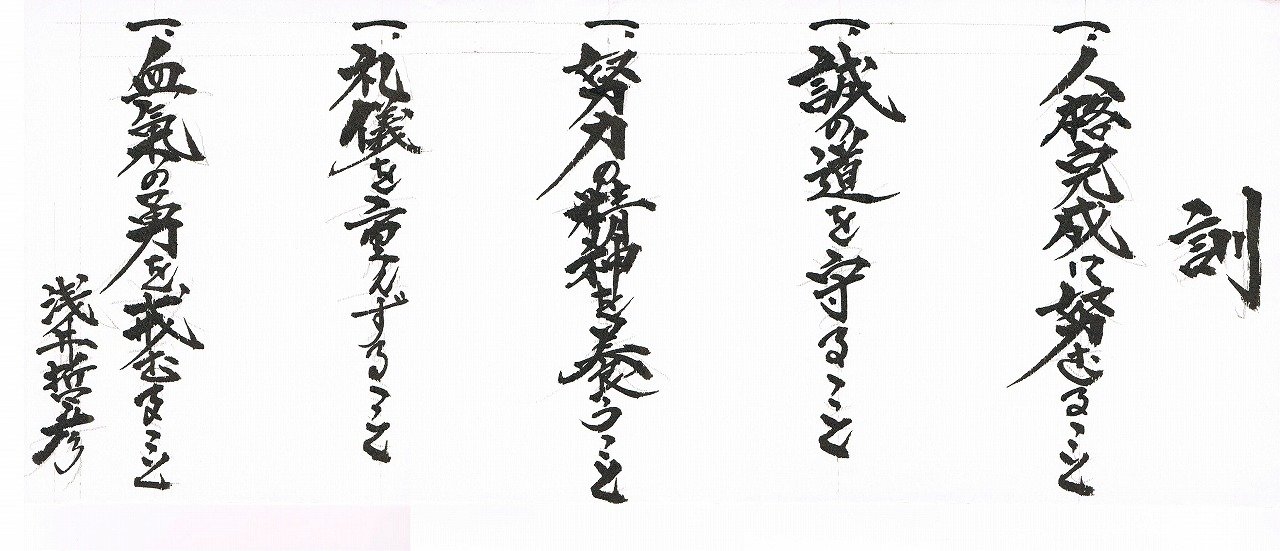
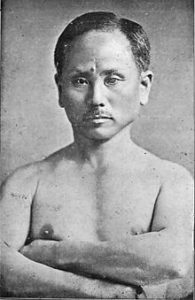
Funakoshi had trained in both of the popular styles of Okinawan karate of the time: Shorei-ryu and Shorin-ryu. Shotokan is named after Funakoshi’s pen name, Shoto, which means “waving pines”. Kan means training hall or house, thus Shotokan referred to the “house of Shoto”. This name was coined by Funakoshi’s students when they posted a sign above the entrance of the hall at which Funakoshi taught. In addition to being a karate master, Funakoshi was an avid poet and philosopher who would reportedly go for long walks in the forest where he would meditate and write his poetry.[6]
By the late 1910s, Funakoshi had many students, of which a few were deemed capable of passing on their master’s teachings. Continuing his effort to garner widespread interest in Okinawan karate, Funakoshi ventured to mainland Japan in 1917, and again in 1922.[2]
In 1930, Funakoshi established an association named Dai-Nihon Karate-do Kenkyukai to promote communication and information exchange among people who study karate-do. In 1936, Dai-Nippon Karate-do Kenkyukai changed its name to Dai-Nippon Karate-do Shoto-kai.[7] The association is known today as Shotokai, and is the official keeper of Funakoshi’s karate heritage.
In 1936, Funakoshi built the first Shotokan dojo (training hall) in Tokyo. While on the Japanese mainland, he changed the written characters of karate to mean “empty hand” instead of “China hand” (literally Tang dynasty) to downplay its connection to Chinese boxing. Karate had borrowed many aspects from Chinese boxing. Funakoshi also argued in his autobiography that a philosophical evaluation of the use of “empty” seemed to fit as it implied a way which was not tethered to any other physical object.
Funakoshi’s re-interpretation of the character kara in karate to mean “empty” (空) rather than “Chinese” (唐) caused some tension with traditionalists back in Okinawa, prompting Funakoshi to remain in Tokyo indefinitely.[citation needed] In 1949 Funakoshi’s students created the Japan Karate Association (JKA), with Funakoshi as the honorary head of the organization. However, in practice this organization was led by Masatoshi Nakayama. The JKA began formalizing Funakoshi’s teachings.